Dyads, Triads, and Network Dynamics
Week 4 Overview
Key Questions:
- Why do networks look the way they look?
- What processes generate network structures?
- How can we test for and model these processes?
Topics:
- Taxonomy of network formation mechanisms
- Dyadic and triadic processes
- Statistical tests for network effects
- Exponential Random Graph Models (ERGMs)
- Network dynamics
Why Do Networks Look the Way They Look?
Networks are not random - they exhibit consistent structural patterns:
- Clustering: Friends of friends tend to be friends
- Degree heterogeneity: Some nodes have many connections, others few
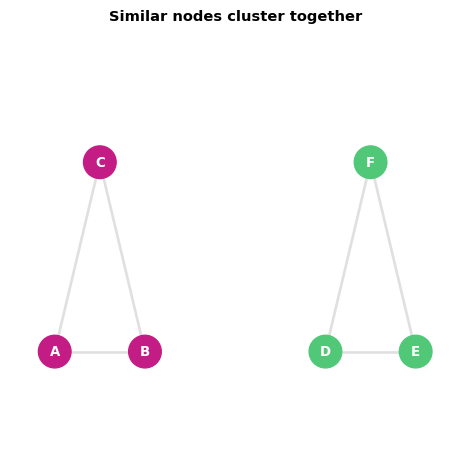
- Homophily: Similar nodes connect more often
- Small world: Short path lengths despite local clustering
Central Question: What social, biological, or physical processes create these patterns?
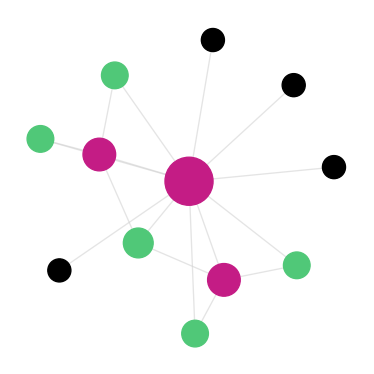
Typical network: hubs, clusters, paths
Taxonomy of Network Effects
Major categories of network formation processes:
| Dyadic |
Two-node processes |
Homophily, reciprocity |
| Triadic |
Three-node processes |
Transitivity, balance |
| Higher-order |
Four+ node processes |
K-cores, cliques |
| Node-level |
Individual preferences |
Preferential attachment |
| Exogenous |
External factors |
Geography, institutions |
Dyadic Processes: Definition
Dyadic processes operate on pairs of nodes (dyads)
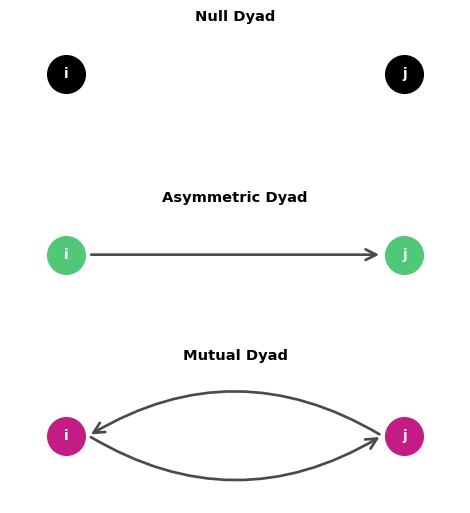
A dyad can be in three states:
- Null: No connection (i → j and j → i both absent)
- Asymmetric: One-way connection (i → j OR j → i)
- Mutual: Two-way connection (i → j AND j → i)
Dyadic processes explain why specific pairs of nodes connect
Dyadic Process: Reciprocity
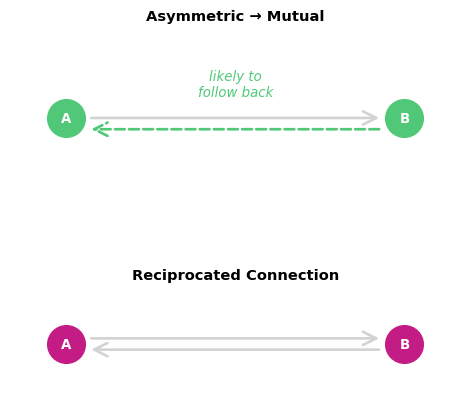
Definition: The tendency for directed edges to be reciprocated
Mechanism: If i → j exists, j → i becomes more likely
Examples:
- Social media: You follow back those who follow you
- Collaboration: Co-authorship often becomes bidirectional
- Trade: Countries with import relationships develop export relationships
Statistical signature: Higher proportion of mutual dyads than expected by chance
Dyadic Process: Homophily
Definition: “Similarity breeds connection” - nodes with similar attributes connect more
Types:
- Demographic: Age, gender, ethnicity
- Behavioral: Interests, activities
- Status: Education, occupation
Formula: \(Pr(e_{ij} = 1 | phi(A_{i}, A_{j}))\)
where \(\phi\) is a similarity or distance function.
Empirical Evidence:
- Wikipedia editors (Crandall et al., 2008): Editors with similar editing patterns more likely to communicate
- University email network (Kossinets & Watts, 2006): Students taking same classes form connections at higher rates
Dyadic Process: Homophily vs Selection
Critical distinction:
- Selection (homophily): Similar people connect
- Influence: Connected people become similar
Problem: Observational data shows correlation, not causation!
Empirical example - Wikipedia editors (Crandall et al., 2008):
- Tracked similarity over time relative to first communication
- Before contact: Rapid increase in similarity (selection)
- After contact: Continued slower increase (influence)
- Both processes operate simultaneously!
Solutions:
- Longitudinal data tracking changes over time
- Statistical models that separate effects (e.g., SAOMs)
- Natural experiments
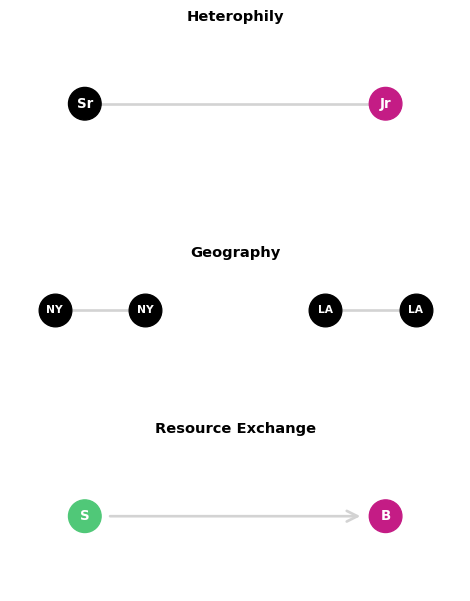
Other Dyadic Processes
Heterophily: Attraction to difference (opposite of homophily)
- Example: Dating networks, mentor-mentee relationships
Distance/Geography: Physical proximity increases connection probability
- Example: Friendship networks, communication patterns
Status homophily: Nodes connect within same status level
- Example: Corporate networks, academic citations
Resource exchange: Complementary needs drive connections
- Example: Economic networks, mutualistic relationships
Triadic Processes: Definition
Triadic processes involve three nodes forming triangles
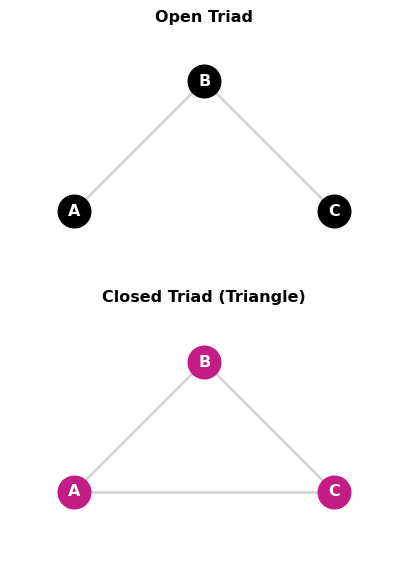
Key configurations:
- Open triad: A-B, B-C exist but A-C absent
- Closed triad (triangle): A-B, B-C, and A-C all exist
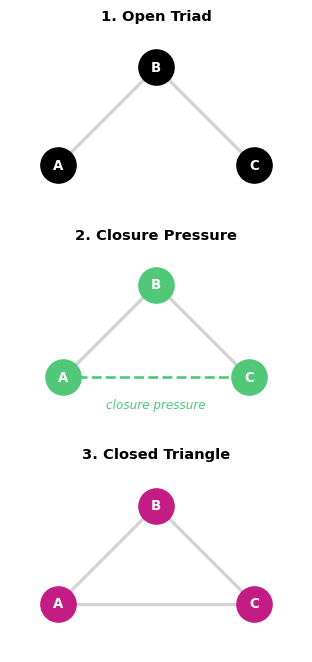
Core insight: The presence of two edges affects the probability of the third
Triadic Process: Transitivity
Definition: “Friends of friends become friends”
Mechanism: If A→B and B→C, then A→C becomes more likely
Also called: Triadic closure, clustering
Examples:
- Social networks: Introduced through mutual friends
- Academic collaboration: Co-authors of co-authors collaborate
- Protein networks: Proteins interacting with same partner interact
Measurement: Clustering coefficient, transitivity ratio
Empirical Evidence: Triadic & Focal Closure
Kossinets & Watts (2006)3: Email network at large US university
Data: ~22,000 students over one year
Key findings:
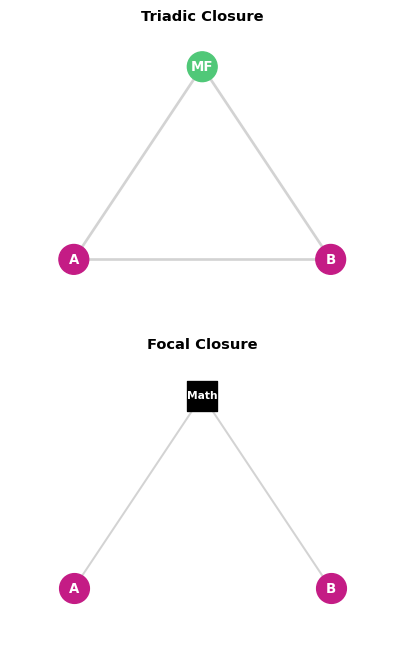
Triadic closure (shared friends):
- Probability increases roughly linearly with common friends
- Strong effect: 2 common friends > 2× effect of 1 friend
Focal closure (shared activities/classes):
- First shared class has similar effect to one friend
- Diminishing returns for additional classes
- Curve levels off (different from triadic closure)
Implication: Both structural and contextual effects matter!
3 Kossinets, G., & Watts, D. J. (2006). Empirical analysis of an evolving social network. science, 311(5757), 88-90.
Focal vs Membership Closure: Key Distinction
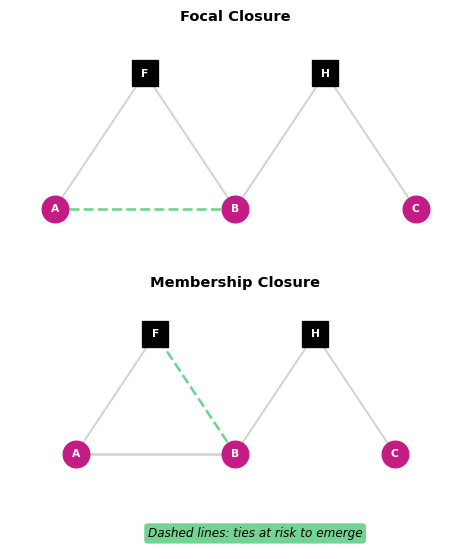
Focal Closure (Easley & Kleinberg, 2010)2:
- People meet through shared activities/contexts (foci)
- Examples: Classes, workplaces, clubs, events
- Mechanism: Physical proximity + repeated interaction
- Pattern: Bipartite structure (people ↔︎ activities)
Membership Closure:
- People connect through shared group memberships
- Examples: Organizations, committees, teams
- Mechanism: Formal affiliation creates opportunities
- Pattern: Overlapping group boundaries
Key insight: Context matters as much as network structure!
2 Easley, D., & Kleinberg, J. (2010). Networks, crowds, and markets: Reasoning about a highly connected world (Vol. 1). Cambridge: Cambridge university press.
Triadic Process: Balance Theory
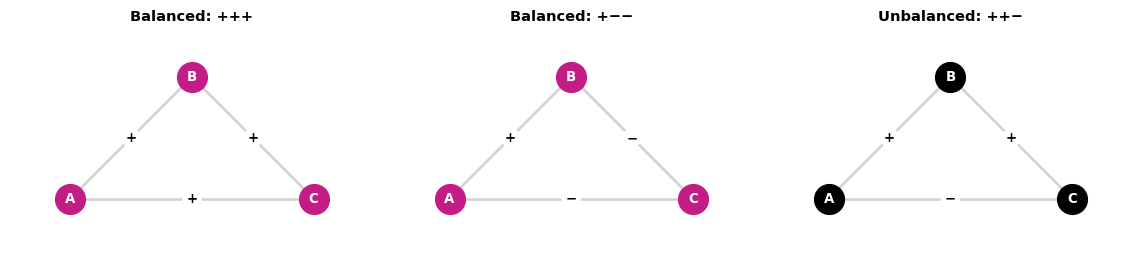
Structural balance (Heider, 1946): Cognitive consistency in signed networks
Balanced triangles (all relationships consistent):
- +++: Three mutual friends (stable)
- +–: Two enemies share a common enemy (stable)
Unbalanced triangles (tension):
- ++-: Friend of friend is enemy (unstable)
- —: Three mutual enemies (unstable)
Prediction: Networks evolve toward balanced states
![]()
Triadic Configurations in Directed Networks
16 possible triadic configurations (triads census)1:
Key patterns:
- 003: Empty (no edges)
- 012: One edge only
- 102: Two edges, no transitivity
- 030T: Transitive triple
- 300: Complete triangle
Different processes favor different configurations
Each tells us something about network formation mechanisms!
1 Vladimir Batagelj and Andrej Mrvar, A subquadratic triad census algorithm for large sparse networks with small maximum degree, University of Ljubljana, http://vlado.fmf.uni-lj.si/pub/networks/doc/triads/triads.pdf
Triadic Process: Cyclicity vs Transitivity
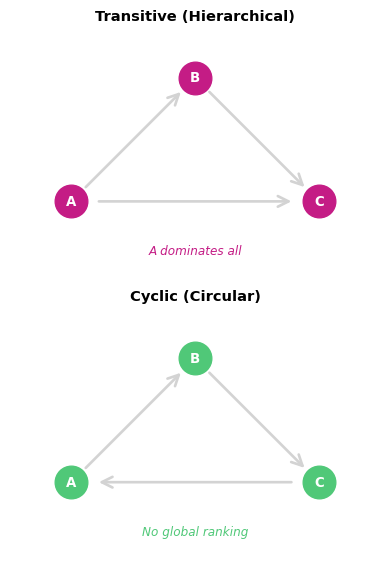
Transitivity: A→B→C implies A→C (hierarchical)
- Creates hierarchies, rankings
- Example: Citation networks, food webs
Cyclicity: A→B→C implies C→A (circular)
- Creates exchange cycles
- Example: Rock-paper-scissors, circular status
Distinction matters for understanding network function!
Statistical Tests for Network Effects
Challenge: Network data violates independence assumptions
Classical approach fails: Standard statistical tests assume independent observations
Solutions:
- Permutation tests: Randomize while preserving structure
- Conditional Uniform Graph (CUG) tests: Compare to random graphs
- Quadratic Assignment Procedure (QAP): Correlation with permutation
Permutation Tests for Networks
Logic:
- Calculate observed statistic (e.g., clustering)
- Generate random networks preserving certain properties
- Calculate statistic on random networks
- Compare: Is observed value extreme?
Key decision: What to preserve when randomizing?
- Node degrees?
- Number of edges?
- Dyad distributions?
QAP Regression
Quadratic Assignment Procedure: Test relationship between network matrices
Use case: Does network Y depend on network X?
Example: Does friendship (Y) depend on geographic proximity (X)?
Procedure:
- Regress Y on X, get coefficient β
- Permute rows/columns of Y simultaneously
- Repeat regression, get β*
- Repeat 1000+ times
- P-value: proportion where |β*| > |β|
Advantage: Accounts for network dependencies
Exponential Random Graph Models (ERGMs)
Core idea: Model probability of observing a network as function of its features
Form: \[P(Y = y) = \frac{1}{\kappa} \exp\left(\sum_k \theta_k s_k(y)\right)\]
Where:
- \(Y\): Random network
- \(s_k(y)\): Network statistics (edges, triangles, etc.)
- \(\theta_k\): Parameters (effects to estimate)
- \(\kappa\): Normalizing constant
ERGM: Intuition
Think of it as logistic regression for networks
Instead of: P(person votes yes) = f(age, income, …)
We have: P(network has this structure) = f(edges, triangles, homophily, …)
Key insight: Model entire network as outcome, not individual ties
Advantages:
- Tests multiple mechanisms simultaneously
- Controls for confounding effects
- Provides effect sizes, not just significance
Common ERGM Terms
edges |
Density |
Overall connection probability |
mutual |
Reciprocity |
Tendency for reciprocation |
triangle |
Transitivity |
Tendency for closure |
nodematch("attr") |
Homophily |
Same-attribute connection |
nodecov("attr") |
Attribute effect |
Node attribute influence |
gwesp |
Shared partners |
Weighted transitivity |
Model specification: Choose terms based on theory!
ERGM: Interpretation
Positive coefficient (θ > 0): Configuration is more likely than chance
Negative coefficient (θ < 0): Configuration is less likely than chance
Example interpretation:
edges: -2.5    (low baseline density)
mutual: 1.8    (strong reciprocity)
triangle: 0.4  (moderate transitivity)
nodematch("gender"): 0.6  (gender homophily)
Reading: Controlling for density, reciprocity, and triangles, same-gender ties are more likely
ERGM: Challenges
Degeneracy problem: Some specifications lead to extreme networks
- All edges or no edges
- Complete clustering or no clustering
Computational challenge: Calculating κ is often intractable
Solutions:
- Use geometrically-weighted terms (GWESP, GWDSP)
- Markov Chain Monte Carlo (MCMC) estimation
- Careful model specification and testing
Network Dynamics Models
So far: Models of static networks (single time point)
Reality: Networks evolve over time
Dynamic approaches:
- Temporal ERGMs: ERGMs on network changes
- Stochastic Actor-Oriented Models (SAOMs): Actor-driven change
- Relational Event Models (REMs): Continuous-time interactions
Stochastic Actor-Oriented Models
Key assumption: Actors make rational decisions about ties
Process:
- Actors get random opportunities to change ties
- They evaluate potential changes via utility function
- They choose change that maximizes utility
Utility function includes:
- Structural preferences (transitivity, reciprocity)
- Attribute preferences (homophily)
- Costs and benefits
Software: RSiena package in R
Advantage: Separates selection from influence effects!
Comparing Modeling Approaches
| ERGM |
Static |
What structure? |
Multiple mechanisms |
| SAOM |
Panel |
How does it change? |
Selection vs influence |
| REM |
Continuous |
When do events occur? |
Precise timing |
| TERGM |
Discrete steps |
What changes? |
Network evolution |
Choice depends on:
- Data structure (cross-sectional vs longitudinal)
- Research question (structure vs process)
- Computational resources
Summary: Key Takeaways
Network structure emerges from systematic processes, not randomness
Dyadic processes (reciprocity, homophily) explain pairwise connections
Triadic processes (transitivity, balance) explain local clustering
Statistical tests must account for network dependencies (permutation, QAP)
ERGMs model network probability as function of multiple mechanisms
Dynamic models capture how networks evolve over time
Next steps: Applying these models to real data!
Further Reading & Resources
Core texts:
- Lusher, Koskinen & Robins (2013). Exponential Random Graph Models for Social Networks
- Snijders, van de Bunt & Steglich (2010). “Introduction to SAOMs”
- Wasserman & Faust (1994). Social Network Analysis
Software:
statnet package (R): ERGMsRSiena package (R): SAOMsigraph package (R/Python): Basic network analysis
Online resources: INSNA workshops, Summer institutes